Horus 3 min read
How to research a reporter before you pitch

Before you pitch a reporter, read enough of their recent work to explain why your story belongs in their inbox. A beat label and a personalized opening line will not do that job.
A useful starting point is three recent stories. Read them closely enough to describe the questions the reporter keeps returning to.
1. Write down what you can offer
Start with a sentence about the news and a sentence about the proof. For example: “Our client measured how AI support tools performed across 200 deployments. We can share the methodology, failure cases, and a customer willing to speak.”
That gives you something to match against coverage. “Our client is an innovative AI company” gives you almost nothing.
Also separate what you have from what you hope to secure. An unnamed customer who has not agreed to an interview is a gap in the pitch.
2. Read across a recent stretch of work
Search the topic, find possible reporters, and read several relevant stories for each. Note dates and bylines. Check their current publication or professional page before you contact them.
Look beyond repeated nouns. Two people might cover enterprise AI, while one investigates vendor economics and the other writes practical buying advice. The first might need financial evidence. The second might need a buyer who can explain the implementation.
In Horus, start with stored coverage and the reporter profile. Use the profile to orient yourself, then open the evidence. If the relevant material is old or thin, widen the search before drawing a conclusion.
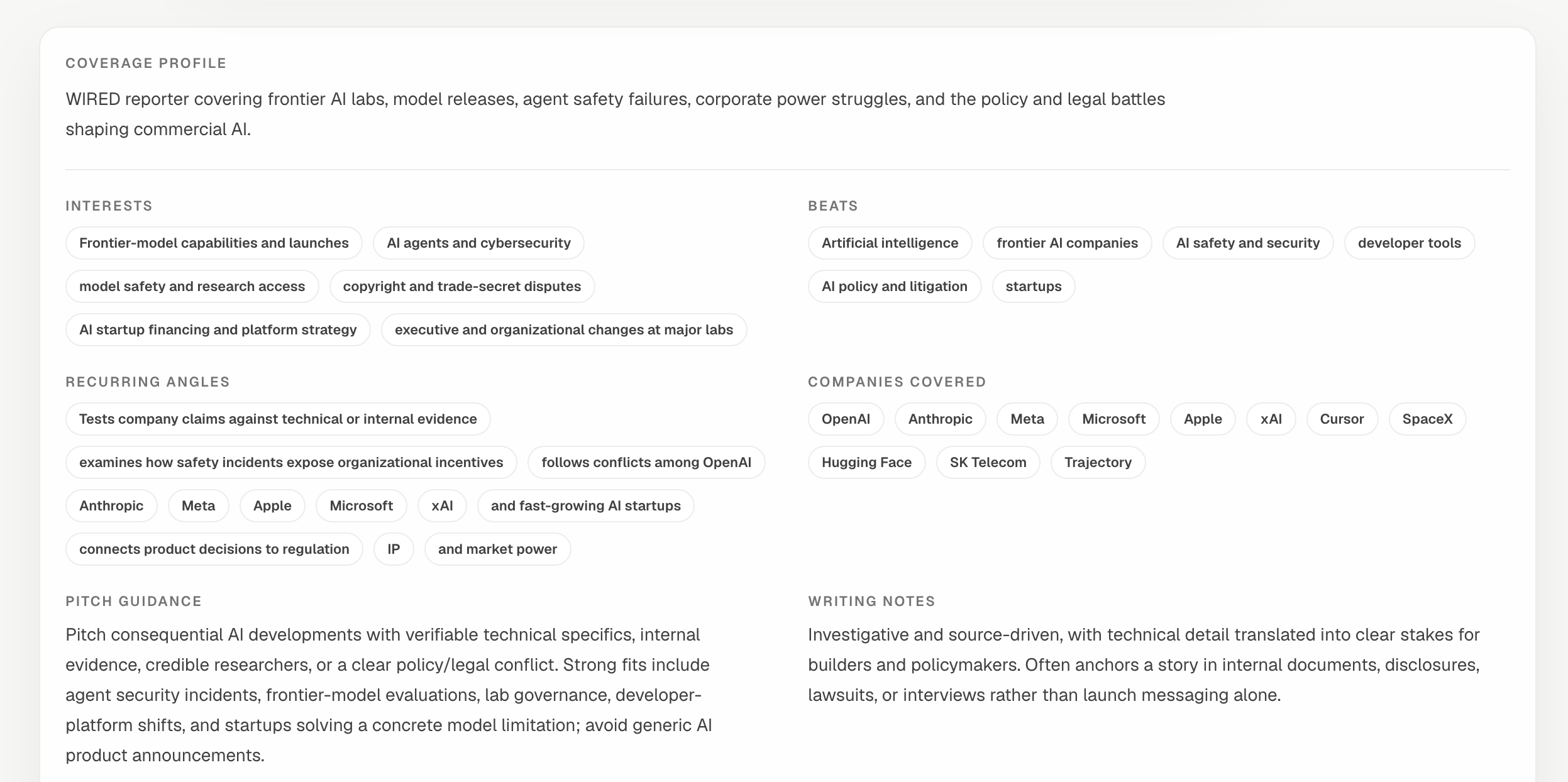 Start with the profile, then read the stories behind the parts relevant to your pitch. View full size ↗
3. Write a fit sentence
Complete this sentence for every serious target:
This reporter has been examining ___; we can contribute ___, supported by ___.
If the first blank is “technology” and the second is “our CEO's thoughts,” keep researching. If the connection requires three paragraphs, it probably needs work.
A useful fit sentence might be: “This reporter has examined the hidden costs of AI rollouts; we can contribute a deployment study with measured support costs and a customer interview.”
4. Give yourself a reason to say no
Check what could make the target unsuitable. They may have just covered the same finding. Your evidence may concern small businesses while their readers run large enterprises. The pitch may require a level of technical detail your spokesperson cannot provide.
Ask an agent to find these objections alongside its recommendations. Save the links and dates so a colleague can review the shortlist without repeating the search.
Anirban Ghoshal · InfoWorld. Start here if the study includes developer workflows. His report on correcting AI-generated output already explores hidden labor costs. Offer the methodology and an engineering team willing to discuss its results.
Michael Nuñez · VentureBeat. His coverage of Writer’s agent-cost claims suggests a broader enterprise angle. Lead with a finding that tests whether vendor savings survive real deployment; a generic survey about AI enthusiasm would be a weaker fit.
5. Draft after the research
Lead with the finding or news. Explain the connection in one sentence. Offer the evidence and access you can deliver.
Keep the fit sentence and the source links with your shortlist. When a colleague asks why someone is on it, you should have a better answer than “they cover AI.”
Expanding beyond traditional outlets? Use the same approach to find newsletters, podcasts, and Substacks.