Horus 3 min read
Horus vs. Meltwater: broad monitoring or focused research?

Meltwater and Horus overlap in media monitoring, but teams may buy them for different reasons. Meltwater covers a broad communications remit across media and social channels. Horus concentrates on reading coverage, researching reporters, and preparing work with AI agents.
For a tech PR team, the choice often comes down to where the work is piling up. Do you need wider monitoring across markets? Or do you need help turning the coverage you already find into a better pitch or client brief?
Breadth matters
Meltwater's product portfolio spans media intelligence, social listening, media relations, influencer marketing, and AI visibility. If several departments depend on that coverage and reporting, a focused research tool won't replace the whole system.
Horus brings publication monitoring, reporter profiles, client briefings, reports, and AI-answer tracking into one workspace. Its Archive contains more than 300,000 stories. You can add missing publications yourself, including specialist sources with accessible feeds.
Check the outlets you need before making a decision. Horus doesn't claim equivalent source coverage or comprehensive social and broadcast monitoring.
How much does Meltwater cost?
Vendr's tracked contracts show roughly $5,000–$57,000 a year in US dollars. Meltwater prices by configuration; team size, modules, and coverage needs can put your quote outside that observed range.
What MCP access gives you
Meltwater's MCP documentation describes tools for accessing its existing saved searches, tags, mentions, and analytics. Your agent supplies the reasoning. MCP makes those capabilities available outside the app; it doesn't create a new research workflow on its own. Access depends on the products in your subscription.
Meltwater separately offers Mira, its assistant for producing answers and briefs. That deserves its own evaluation. Don't assume a connection to an AI assistant tells you how much work that assistant can do.
Horus combines agent access with prepared research: stored stories and profiles that describe a reporter's recurring interests, angles, and pitch criteria. You can ask an agent to examine the coverage, compare possible targets, and find weaknesses in your proposed angle. You can also open Horus and read the same material yourself.
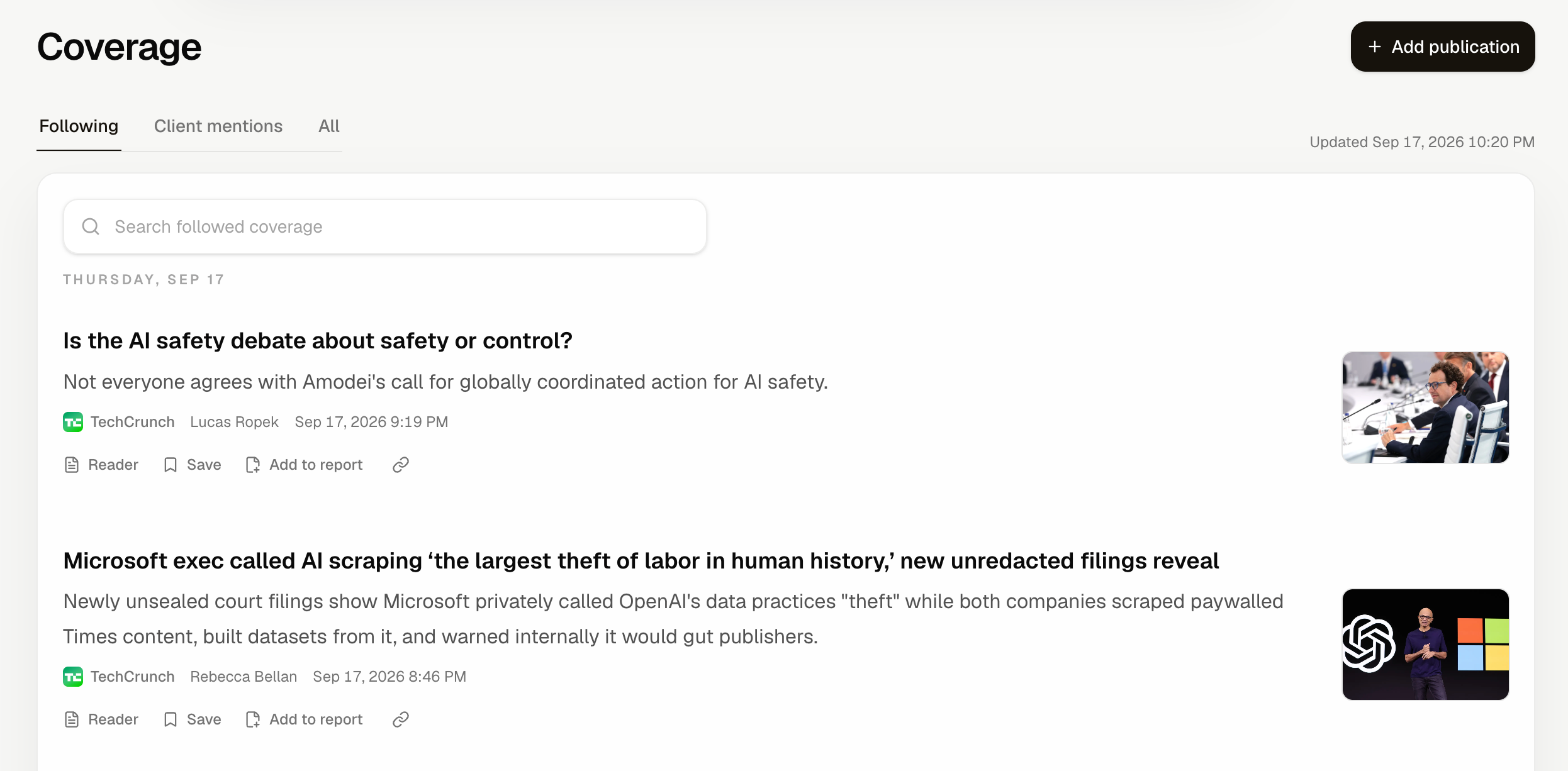 Horus gives the team a place to read the coverage its research draws on. View full size ↗
Do cheaper tokens mean cheaper work? Michael Nuñez’s VentureBeat report on Writer describes how agent loops multiply consumption. Break your results down by completed task so readers can compare the total bill.
Who pays for the cleanup? Anirban Ghoshal’s InfoWorld reporting follows the extra prompts and human effort needed to fix AI output. Show how often people intervene and how much time that takes.
Compare the work you do every week
Choose one client and a topic. Find the week's relevant coverage, investigate three potential targets, and prepare something you would send to a colleague. Note the sources you missed and the research you had to do elsewhere.
Try it on your phone, too. If a tool is meant to help you follow the news, you should be able to use it where you read the news.
You may keep Meltwater for broad monitoring and use Horus for focused research. You may find that a smaller set of tools covers your needs. Start with those needs rather than the length of either feature list.
For a comparison centered on media relations, see Horus vs. Muck Rack.