Horus 3 min read
Horus vs. Muck Rack: which is better for your PR team?

If your team already uses Muck Rack, you probably have media lists, a contact database, and a way to track outreach. The question is how much work remains after you find a name.
You still need to read the reporter, understand their interests, and work out why your story fits. Horus is built around that preparation. It combines coverage, detailed reporter profiles, and agent tools in a workspace you can use throughout the day.
What you get from Muck Rack
Muck Rack's media database offers journalist discovery, recent coverage, maintained profiles, and team collaboration. Its broader platform supports established media-relations workflows. Breadth and familiarity are good reasons to keep using it, particularly when a team already has its process there.
Horus doesn't replace an outreach CRM or send pitches. You can use it alongside Muck Rack to research a story, read coverage on your phone, and share findings with colleagues.
How much does Muck Rack cost?
Vendr's tracked contracts show roughly $8,000–$21,000 a year in US dollars. Muck Rack quotes each package individually; team size, features, and contract terms can put your quote outside that observed range.
Where the AI fits
Muck Rack's AI Search Assistant turns a request into a search. Its Media List Agent recommends people to add or remove and explains why. These features put a conversational interface around familiar database and list-building tasks.
That's useful, but it leaves a question: how well does the tool help you understand the reporter once you've found them?
In Horus, a profile describes recurring interests, reporting angles, companies covered, and pitch criteria. You can inspect the source stories or ask your agent to read them. The aim is to make distinctions that a broad filter misses: someone who investigates AI safety failures needs different material from someone who reviews AI coding tools.
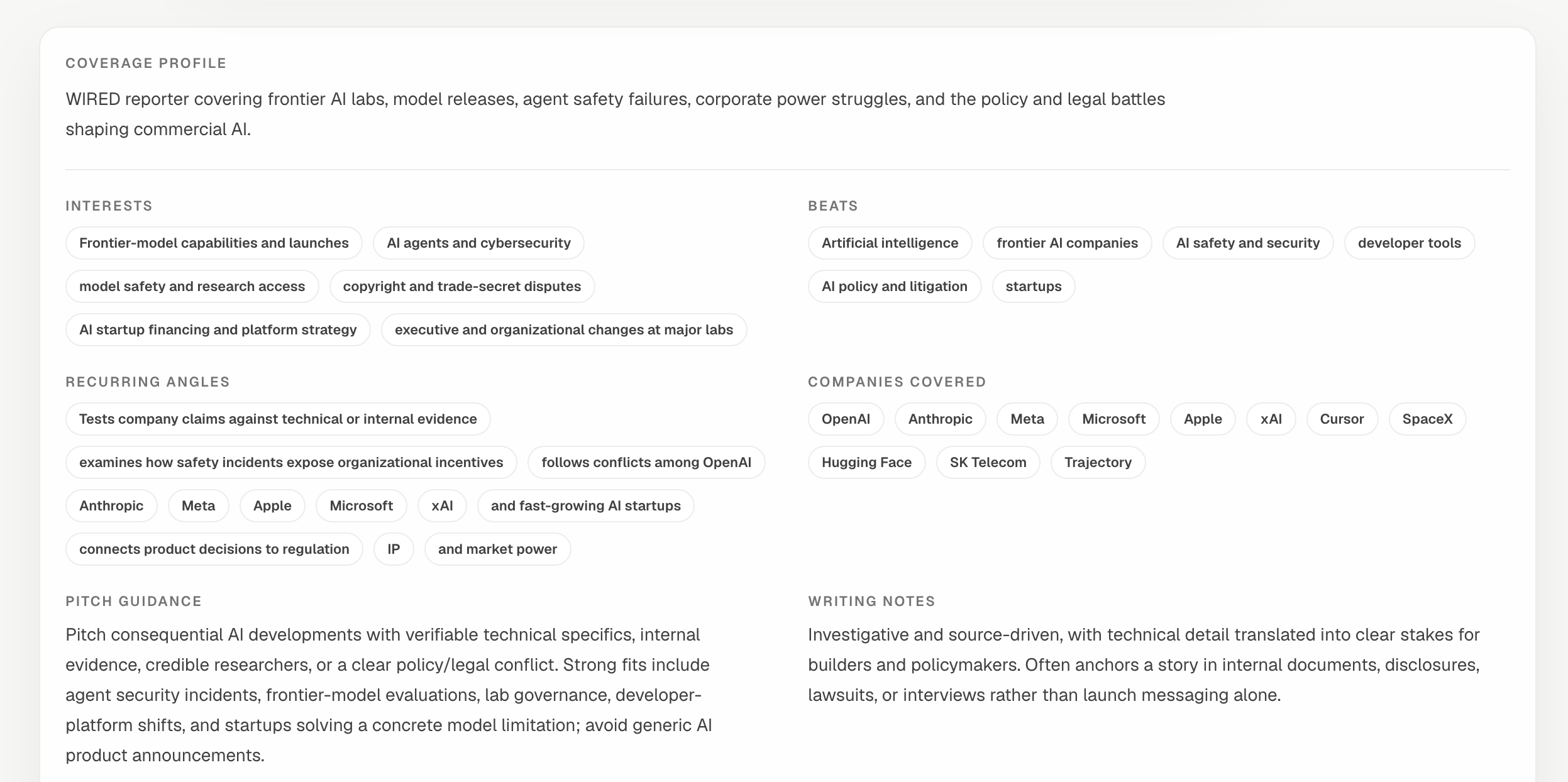 The research should explain what kind of story fits, as well as who covers the topic. View full size ↗
An agent can then help you test the pitch. Does your evidence address a question this reporter keeps asking? Has the same finding already been covered? What would make the story stronger? Those are the questions we want Horus to help answer.
Anirban Ghoshal · InfoWorld. His reporting on the hidden cost of correcting AI output connects model failures to developer time and token bills. Lead with the benchmark method, repeatable failures, and the cost of fixing them.
Alex Konrad · Upstarts. He covered a startup’s claims about coding-agent sandbox weaknesses. A fit if your findings concern security: offer a reproducible demonstration and explain what you disclosed to the vendors.
A useful way to compare them
Take an announcement you're preparing and research five targets in each product. Read the supporting coverage. See whether the recommendations survive a second look—and whether you can explain the fit to a colleague without repeating all the research.
If your team needs a broad media database and an established outreach process, Muck Rack has a clear role. If finding the names is easy but preparing a good pitch still takes hours, that's the part of the job to try in Horus.
Also considering a broader monitoring platform? Read Horus vs. Meltwater.